
Read the blog on Psychology Today
Sarah found herself at a crossroads. She had spent 20 years in her company, and that counted for something. People listened to her in meetings, her opinion was valued, and if she asked for something to be done, invariably it would be.
But that seemed to be changing. Her company had just been bought by a larger business, and new people were running her department. Given that and an influx of younger colleagues, she felt less appreciated and less visible.
It’s easy to take our social capital for granted. Social capital is often defined as “The goodwill available to individuals or groups. Its source lies in the structure and content of the actor’s social relations. Its effects flow from the information, influence, and solidarity it makes available to the actor.” In other words, it’s the support we get because of our relationships with others. If we lose the relationships, as Sarah was experiencing, we lose the support and the influence that goes with it.
“Real Influence”
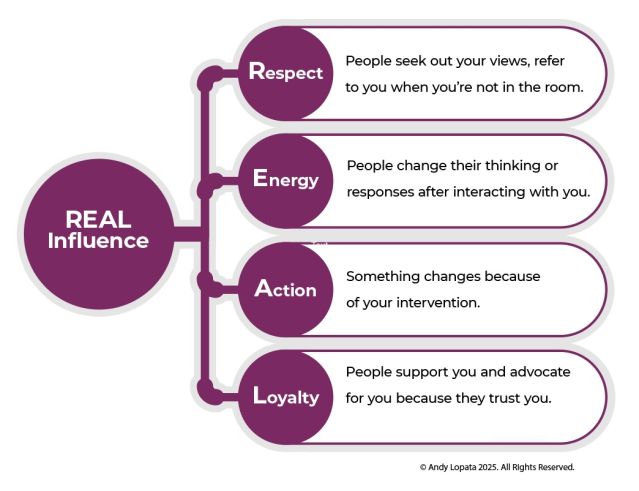
Lacking a job title to garner support and influence, Sarah needed to rebuild her relationships and find a way to re-establish her authority without formal power. That meant going back to developing relationships and measuring her progress using a model I have developed, to identify how to establish real Influence:
- Colleagues Respect her perspective and seek her out to weigh in on crucial decisions;
- People feel Energised after speaking with her;
- Her input leads to people taking Action;
- Because of the Loyalty she has personally gained through her relationships, people follow her lead, not just because her suggestions resonate.
Respect
Automatic authority is fading. Even if Sarah did have a job title that gave her seniority, it might not count for much as younger generations join the workforce. Multiple studies and industry reports show that Gen Z values influence, autonomy, and real impact over job titles and positions of formal authority. Traditional hierarchies don’t impress them; leaders need to gain influence in other ways.
People in a modern workforce increasingly resist being told what to do, but they do respond to those they know and respect. They seek people whose judgment they trust and whom they see adding value, to them personally and to the organisation, or to society, as a whole.
Energy and Action
Influence is driven by emotion and proven through behaviour. It’s easy to fall into the trap of trying to influence people by the strength of your argument. You need to be able to back up your ideas and create a convincing argument, but if people don’t emotionally engage with what you are saying, it’s less likely they will be driven to follow you.
The energy you bring to a discussion can transform a conversation and how people relate to you. People are more likely to take action if your energy aligns with how they feel at that moment, so you need to seek rapport, demonstrate empathy, and create an emotional connection when seeking to influence others.
By inspiring others to engage with your message, you can encourage them to take action differently because of those words. The actions others take are the ultimate and most visible markers of whether you are influencing them effectively.
Loyalty
Influence is personal. You know that you have deep influence in an organization when people buy into your ideas and contributions because they come from you. Your ideas are challenged and dissected less because you are trusted and probably have a track record of being right.
When time is short or the stakes are high, that trust is extremely powerful. People rely on their experience of working with someone before; loyalty and trust form shortcuts, particularly in uncertain environments.
Influence that Matters
The challenge Sarah faced isn’t unique. Many experienced professionals are finding that authority based on tenure or title is no longer enough. Influence now rests on something more personal, more human—and more powerful.
Sarah realised that being heard wasn’t just about what she said but about how she made people feel. By focusing on respect, she earned her place at the table again—not because of her title but because others sought her insight. Her renewed energy lifted the people around her. Her input inspired action, and, over time, she saw something else shift—loyalty. People started backing her ideas not just because they made sense but because they came from her.
Influence without authority isn’t a consolation prize. It’s the new currency of leadership—and the real reason people will listen to you.
References
Adler, Paul S., and Seok-Woo Kwon. 2002. “Social Capital: Prospects For a New Concept.” Academy of Management Review, 27(1), 17-40
Taylor, Alison, 2024. Why Gen Z Needs a New Kind of Company Culture. People Management.
Petty, R. E., & Briñol, P. (2015). Emotion and persuasion: Cognitive and meta-cognitive processes impacting attitudes. Cognition and Emotion, 29(1), 1–26.