Read the blog on Psychology Today here
It’s one of the most time-honoured pieces of career advice: Have a strong elevator pitch. When asked “What do you do?”, be able to tell someone exactly who you are and what you do in 30 to 60 seconds.
But is the quick-hit pitch really the best way to build meaningful professional relationships?
In practice, elevator pitches are often one-sided, overly rehearsed, and easily forgotten. They feel more like self-promotional monologues than genuine invitations to connect.
Instead of cramming your value proposition into a short burst of speech, invite people into a two-way exchange. Let the relationship evolve through a series of open-ended conversations. This is the concept I call “corridors of conversation”.
Why the Elevator Pitch Falls Short
Elevator pitches prioritise efficiency over connection. They’re designed for speed, as an information dump, not depth and understanding. Humans don’t absorb information well when it’s broadcast at them in a tight package. According to Harvard psychologist Steven Pinker, people process new ideas more effectively when they’re contextualised in back-and-forth dialogue. Others have noted that professional communication works best when it shifts from one-way messaging to genuine mutual exchange.
Elevator pitches stifle natural rapport and feel transactional. They don’t reflect the way most people actually communicate when they want to learn about each other. We’re wired for stories and questions, not scripts.
Kevin the Teenager: The Missed Opportunity in Everyday Conversation
At the other end of the spectrum from elevator pitches, we all encounter frequent, low-stakes opportunities to help others better understand our work—yet regularly let them slip by.
Reflect on our usual responses when someone casually asks, “How’s work?” or “How are things going?” More often than not, our answers are just reflexive placeholders.
“Fine.”
“Busy.”
“Not bad.”
In effect, we shut down the conversation before it starts. We give nothing away and create no opening for curiosity or engagement.
This isn’t just a missed networking opportunity; it’s a missed human connection. Each of such moments is a chance to open the first door in a corridor of conversation.
In the U.K. during the 1990s, a comedy character known as Kevin the Teenager gained fame for his sullen, monosyllabic grunts in response to even the most enthusiastic parental inquiries. While exaggerated for humour, the character reflects something we all occasionally do in adult interactions: We disengage, even when the other person is trying to connect.
What if we treated such moments as invitations rather than interruptions? By offering just a sliver of context—a small glimpse into a recent project, insight, or challenge—we allow others to choose how deeply they want to explore. Some will move on. But others will step into a deeper, more meaningful exchange.
Corridors of Conversation: A More Natural Alternative
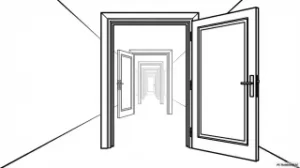
Picture this: You’re standing in a corridor with doors spaced out along the hallway. Each door represents a topic or detail about your work. As you speak to someone new, you gently open the first door, offering a simple, intriguing insight. If they’re interested, they step through. If not, you’re both free to pivot the conversation elsewhere. No pressure. No pitch.
When somebody asks you, “How’s work?” or “What do you do?”, rather than overwhelm with a pitch or underwhelm by batting away the enquiry, invite them into a conversation:
“It’s been an exciting few weeks. I just got back from a client project in India where we tackled an important strategic challenge.”
You’ve just opened a door. If they want to know more, they’ll walk through it:
“Oh? What kind of challenge?”
You reply:
“The client runs a family-owned business that’s scaling rapidly but struggling with some basic growing pains. We helped them implement a new decision-making framework that will ease a lot of the challenges they are facing.”
Another door. Another opportunity to engage or move on. The key is that each insight is offered in a way that invites curiosity. And because the listener has opted in, they’re more likely to retain the information.
The approach mirrors what psychologists call “the curiosity gap,” whereby people are more motivated to learn when they feel in control of their discovery process.

The Drip Drip Effect: Building Understanding Over Time
Corridors of conversation don’t just make introductions easier; they lay the groundwork for deeper, more lasting relationships. Think of each short exchange as a drop of water into a sink. One drop doesn’t do much. But over time, the sink fills up.
You help people gradually get a grip on what you do by drip-feeding meaningful insights across multiple interactions. As a result, people not only understand what you do, they remember it.
Organisational psychologist Adam Grant has written extensively on the power of meaningful small talk to create psychological safety and professional connection. Such moments are not trivial; they shape perception, reputation, and collaboration.
How to Make It Work for You
The beauty of corridors of conversation is simplicity. No scripts. No awkward self-promotion. Just intentional, open-ended dialogue. Here’s how to apply it:
- Lead with something current: Share what you’re working on or recently experienced. For example, “I’ve been immersed in a team restructuring project.”
- Imply the possibility of a story: Let your phrasing spark curiosity. “We’ve just piloted a new mentoring format across Asia.”
- Let them lead the depth: If they want to know more, they’ll ask. If not, you’ve still planted a memorable seed.
- Reciprocate: Ask about their world, too. This reinforces mutuality and strengthens relational trust.
A Human Approach for a Human Workplace
In an era where AI writes bios, pitches, and resumes in seconds, the real competitive advantage lies in how authentically we connect with others. Corridors of conversation shift the focus from performance to presence. From broadcasting to engaging.
So next time you’re asked, “What do you do?”, leave the elevator pitch on the ground floor. Walk down the corridor instead. It’s a slower route, but one far more likely to lead to a meaningful destination.