
You send out a polite request for input. Silence.
You ask a colleague to share the data you need. They promise, but nothing arrives.
You’re left wondering, Why is it so hard to get the support I need at work?
You’re not alone. A May 2024 Gartner survey found that 84% of marketers feel “collaboration drag”—they struggle to get colleagues to back them up, share information, or take action. The cost is steep: missed revenue goals, burnout among key talent, and teams pulling in different directions.
And it’s not just marketing. Walk into almost any workplace and you’ll find as much competition as collaboration. While organisations often blame too many meetings, unclear roles, or slow feedback loops, there’s a deeper reason colleagues hold back. It’s about the relationship between you and them, not just the task at hand.
Trust Isn’t Based on Competence Alone
While Gartner attributes collaboration drag to too many meetings, unclear roles, and feedback issues, there is another, simpler fundamental reason. When we work with people, we assume that working together for the same organisation will be enough to secure their co-operation, and we ignore the importance of our relationships with our colleagues.
We focus on our own agenda and explain what we need—but rarely stop to ask why the other person would want in the way of help.
Deep professional relationships influence others’ willingness to help us. The Trust Equation, as presented by David Maister, Charles H. Green, and Robert M. Galford in their book The Trusted Advisor, can help us understand the missing elements of our discussions with colleagues.
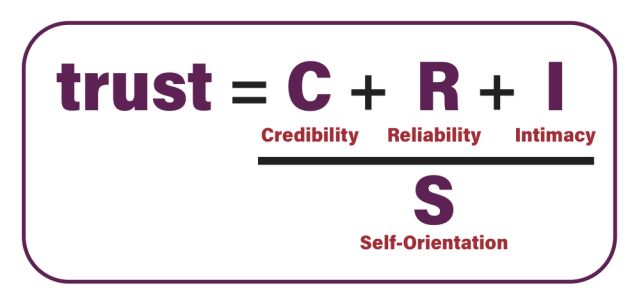
Maister, Green and Galford identify trust as a combination of credibility, reliability, and intimacy, all underpinned by self-orientation.
- Credibility is described as the confidence others have in our expertise, skills, and knowledge.
- Reliability refers to the consistency of our actions and delivery.
- Intimacy relates to the human connection: Do people feel safe confiding in us?
- Self-orientation is the extent to which we focus on others’ needs, rather than just being focused on our own agenda.
Although The Trust Equation was developed specifically with client relationships in mind, the ideas also relate closely to other relationships. Trust plays a significant role in in-house relationships, just as it does in externally facing conversations.
Our natural tendency when engaging with someone professionally is to focus on credibility and reliability. Do we have the relevant background and track record that people can trust us with? If we do, we expect that to be enough to drive the response we’re seeking.
The Overlooked Drivers of Support
In such a context, it’s easy to forget the importance of Intimacy and self-orientation. But both elements provide the missing pieces that motivate people to help us. Unless the other person stands to gain from helping you, or they have been told to do so, what is going to inspire them to do so?
A 2024 study published in Frontiers in Psychology investigated how positive social contact between groups leads to greater cooperation, emphasising that social distance—essentially the lack of emotional closeness—directly mediates the willingness of people to cooperate. The research found a strong and significant correlation between positive intergroup contact (intimacy or closeness) and cooperative behaviour, showing that as intimacy increases, so does willingness to collaborate or assist.
Meanwhile, in an 2018 study on perceived motives and reciprocity, Yesim Orhun demonstrated that, when a helpful act is perceived to be strategically motivated (i.e. the benefactor is seen as doing it to gain something, avoid punishment, or trigger a return), the positive reciprocity elicited by the same act is lower.
In contrast, when the same helpful act is perceived to arise from genuine altruism, the recipient is more inclined to reciprocate—to support or reward—at a higher level.
From Your Needs to Theirs
The next time you identify people who can help you towards your objective, take a step back from your own agenda and think instead about how they view your relationship with them and how important your needs are to them.
What are you doing to create a genuine connection? How much of their agenda do you understand? And what are you doing to demonstrate that you’re not solely focused on how they can help you?
This isn’t about keeping score or trading favours. Instead, build strong relationships ahead of time. When support becomes part of a natural cycle of give and take, people help without hesitation.
If you don’t want to be met by silence when you need the support of your colleagues, invest in your relationships with them, build genuine human connection, and show a deep interest in their work first.
That’s the missing piece of the jigsaw.
References
Gartner, CMOs: How to Succeed at Cross-Functional Collaboration for Growth, February 16, 2024
Maister, David H., et al. The Trusted Advisor. Simon & Schuster, 2001.
R. Xiao and S. Li. The effect of positive inter-group contact on cooperation: the moderating role of individualism. Frontiers in Psychology, March 5, 2024.